




UV/Vis Spectroscopy
UV/Vis spectroscopy for protein and DNA quantification
What is UV/Vis Spectroscopy?
UV/Vis spectroscopy is an analytical technique that measures how much ultraviolet and visible light a sample absorbs across a range of wavelengths. The resulting absorbance spectrum reflects how absorbance changes as a function of wavelength and can be used to quantify concentration and assess sample quality.
Quantification by UV/Vis spectroscopy is based on the Beer–Lambert law, which relates absorbance to concentration, pathlength, and an analyte-specific extinction coefficient. Because proteins and nucleic acids absorb light at characteristic wavelengths, typically 280 nm for proteins and 260 nm for DNA and RNA, UV/Vis spectroscopy is widely used for rapid, reagent-free protein and nucleic acid quantification (Figure 1).
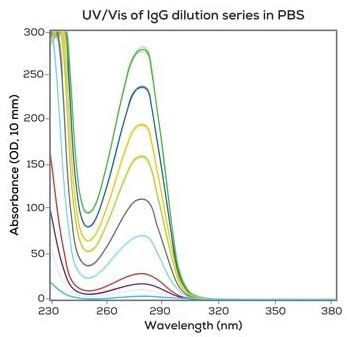
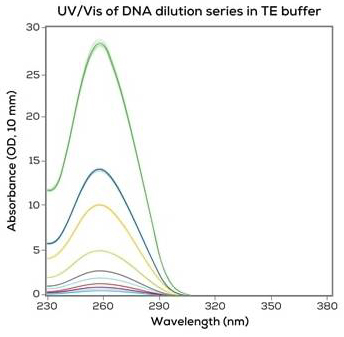
Figure 1. Protein dilution spectra and DNA dilution spectra.
How UV/Vis Is Used for Biomolecular Quantification
UV/Vis spectroscopy is commonly used to quantify proteins, DNA, and RNA in solution by measuring absorbance at characteristic wavelengths. Because absorbance is directly proportional to concentration, UV/Vis enables fast, non-destructive quantification without dyes or reagents.
- Proteins are typically quantified at 280 nm (A280)
- DNA and RNA are quantified at 260 nm (A260)
Using the Beer–Lambert law, concentration is calculated from measured absorbance together with the known pathlength and an analyte-specific extinction coefficient or concentration factor. Modern UV/Vis spectrophotometers perform these calculations automatically, allowing rapid measurements from very small sample volumes.
UV/Vis spectroscopy is also used to assess sample purity using absorbance ratios such as A260/A280 and A260/A230, which can indicate contamination from proteins, salts, solvents, or other absorbing species.
Lunatic and Stunner spectrometers perform high-speed UV/Vis spectral analysis from 230–750 nm across a wide absorbance range (0.03–275 OD) using just 2 μL of sample in fixed pathlength microcuvettes (Figure 2). These microcuvettes are integrated into unique microfluidic circuits that prevent any cross-contamination and evaporation while delivering highly accurate absorbance spectra. Fixed pathlengths enable accuracy on Lunatic and Stunner to within 2% and precision within 1%. For more info on UV/Vis spectroscopy and Lunatic’s underlying technology, check out this tech note.
High Lunatic and Stunner plates have 2 microcuvettes percircuit, with pathlengths of 0.1 and 0.7 mm. The 0.1 mm microcuvette supports measurements at higher absorbance values, while the 0.7mm microcuvette provides improved accuracy at lower absorbances.
Together, these 2 pathlengths enable a wide dynamic range within a single measurement workflow. Lunatic and Stunner read 96 microfluidic circuits on SBS-compatible plates in just10 minutes, supportinghigh-throughput protein quantification across a broad range of sample types and concentrations.
Looking for accuracy? Lunatic and Stunner quality has been validated with Reference Materials (RMs) from the National Institute for Standards and Technology (NIST). NIST provides 3 RMs for testing UV/Vis spectrophotometers: a monoclonal antibody (NISTmAb), tryptophan and uracil – each certified concentrations in defined buffers. Lunatic and Stunner measure these samples within 2% of the certified value (Figure 3), easily meeting both USP and Ph. Eur. guidelines.
UV/Vis spectroscopy is one of the oldest and most well-established methods of directly quantifying proteins, DNA and RNA. Unchained Labs advances UV/Vis quantification throughinnovative optics, well-controlled consumables and refined analysis techniques designed for modern biomolecular workflows..
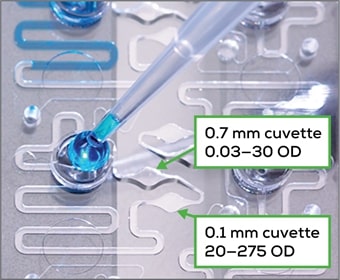
Figure 2. High Lunatic plate circuit.
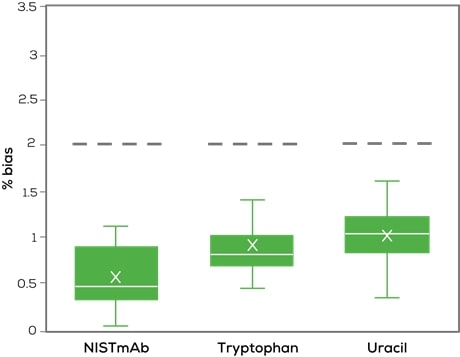
Figure 3. Lunatic and Stunner accuracy of NIST RMs.
All Unchained Labs UV/Vis Spectroscopy instruments deliver:
- Accurate and precise full-spectrum UV/Vis absorbance results from 230–750 nm
- Results from tiny 2 µL sample volumes
- Wicked fast reads
- Wide dynamic range from 0.03 to 275 OD
- IgG quantification from 0.02 – 200 mg/mL
- Nucleic acid quantification from 1.5 - 13750 ng/µL
- Microfluidic circuits to protect samples from evaporation and cross-contamination
- Fixed pathlength microcuvettes for maximum sensitivity and reproducibility
- Purpose-built applications for quantification of purified or non-purified samples
- Low maintenance and no clean-up
Check out our UV/Vis Spectroscopy instrument line-up below, with two solutions designed to solve protein and DNA quantification problems.
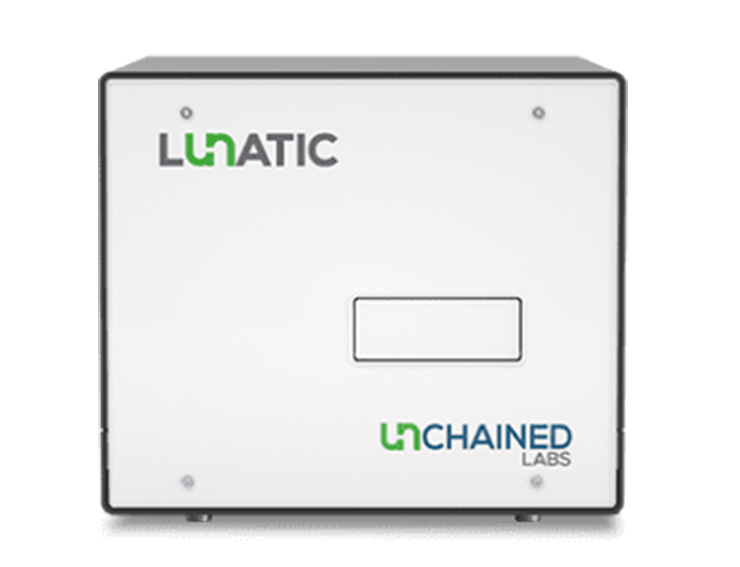
Lunatic
Lunatic makes batch quantification of biologics, DNA and RNA a no-brainer. All you need is 2 µL and 10 minutes to measure up to 96 samples. Run them straight-up, even at high concentrations, without ever diluting. Measurements are spot-on with accuracy within 2% and precision within 1% and are fully compliant with USP and Ph. Eur. guidelines. The SBS plate-based format means integrating with lab automation and liquid handlers is a snap. Lunatic gets UV/Vis quantification on the money every time. Just drop, load and read.
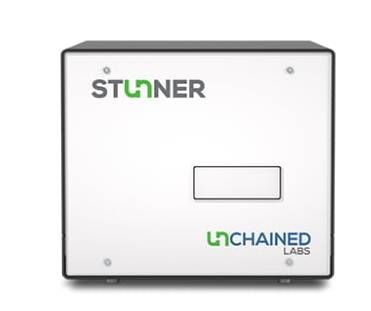
Stunner
Stunner combines Lunatic’s plate-based, high-throughput UV/Vis accuracy and precision with dynamic light scattering for a one-of-a-kind combination. Pairing up these techniques checks concentration, hydrodynamic size, polydispersity and detection of aggregates off your to-do list in one shot. Sync up sample quantity and quality your way.
FAQs
More info
Have a question or can’t wait to find out more?